WTF is Akutagawa?
How a dull Saturday errand led to one of Chicago's most quietly fascinating culinary footnotes.

Thai Patton
My knives needed sharpening. Stick with me, I promise this is going somewhere.
I'd been putting it off for far too long. The kind of domestic task that feels optional until the moment it very clearly isn't. On an auspicious Saturday morning I found a place that specialized in sharpening Japanese steel. I wandered to see Mike at The Sharp Edge in Logan Square, handed them over, and found myself with an hour to kill and a stomach that had little more in it than a cup of coffee and a cappuccino.
Fullerton Restaurant. A corner spot. The kind of place that doesn't need a sign that says "since 1972" because it looks exactly like it's been there since 1972. I sat down, picked up a menu, and landed on something that stopped me cold.
Akutagawa.
Or rather, Akatawa, the spelling was questionable, but unabashedly enthusiastic. Either way, I had no idea what I was looking at. The description said eggs, ground beef, onion, bean sprouts, green peppers, rice, brown gravy. My brain filed it somewhere between "diner scramble" and "what the f***." The waitress, a woman short on words, told me it was something I had to try.
She made the decision.
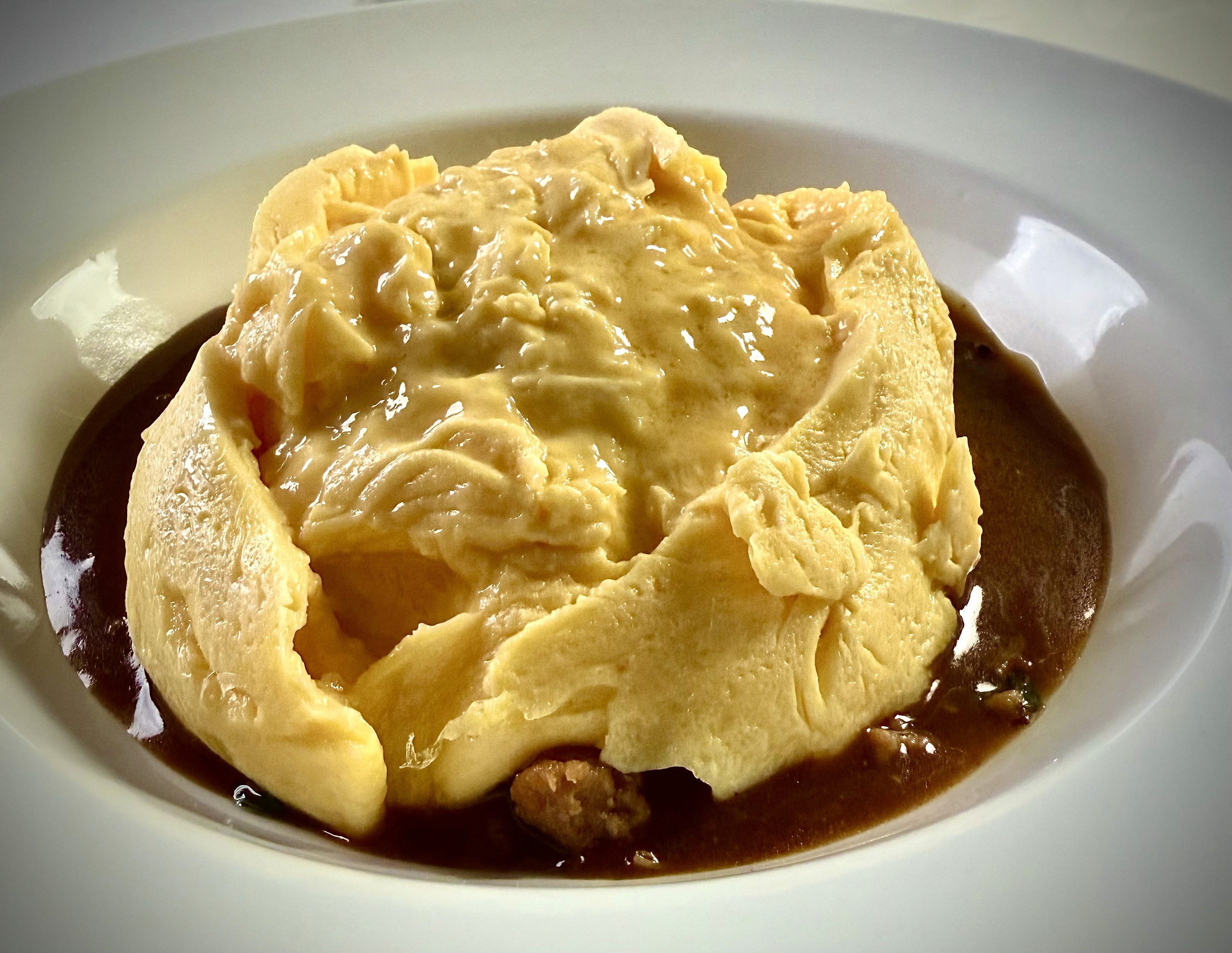
Here's what arrived: a flat-top scramble of eggs cooked with ground beef, onions, bean sprouts, and green peppers, wok energy translated to a diner griddle, piled next to rice and flooded with brown gravy. The waitress set down sriracha and soy sauce on the side. I looked at those two condiments sitting on a wooden table in a very standard greasy spoon, brought to me by a Latina server at a place that doesn't advertise any particular cultural identity, and felt that specific Chicago thing happen: where a dish quietly contains an entire world if you bother to look.
It felt right. Also, I love sriracha.
A quick detour into Yoshoku
Yoshoku is a category of Japanese cuisine that emerged in the Meiji era, when Japan opened its borders and Western food arrived for the first time. Japanese cooks took Western dishes: omurice, hamburger steak, curry rice. They slowly transformed them into something distinctly Japanese. Softer. Richer. More precise. The technique changed, the ingredients adapted, and what came out the other side was neither Western nor traditionally Japanese. It was its own thing.
Akutagawa is the reverse.
It's a diner dish, American as Formica and drip coffee, that absorbed Japanese ingredients and sensibilities until it became something that doesn't fit cleanly into either category. Eggs, beef, rice, gravy: diner. Bean sprouts, soy sauce on the side, the wok technique underneath it all: something else. Not quite Japanese. Not quite American. Born in the middle, which is exactly where Chicago does its best work.
Why Wrigleyville

Here's the part of the story that doesn't get told enough.
After World War II, the U.S. government began releasing Japanese Americans from internment camps (a truly shameful time in our history). Over 100,000 people who had been forcibly removed from their homes on the West Coast and imprisoned, in the name of wartime security, without charge or trial. When the camps closed, they couldn't return to the West Coast. The government dispersed them to large cities east of the Rockies, and Chicago became the largest hub. By the end of the war, the city was home to roughly 20,000 ethnic Japanese.
The government's resettlement program came with an expectation: assimilate. Shed your Japanese identity. Be invisible. Keep your communities small. As one Chicago Japanese American put it simply: "You had to basically be unseen."
They were placed in neighborhoods in transition. In-between spaces of a deeply segregated city. Over time, many settled in Lake View, in the streets around what would eventually become known as Wrigleyville. At its peak in the 1960s and 70s, there were nearly 150 Japanese-owned businesses and institutions in the area: restaurants, markets, beauty salons, dry cleaners. A community that was told not to be a community, being a community anyway.

Nisei Lounge, opened in 1951, gave these displaced Japanese Americans a place to congregate and swap stories. Nisei means second-generation Japanese immigrant. The bar is still there. Go drink an Old Style and appreciate it.
One of those 150 businesses was a diner on Sheffield called Hamburger King. Its owner was Tom Yamauchi, and in the late 1960s, he made something for a friend.
The man himself
The folk legend says it was a regular. A man who would stumble into the restaurant after a long night, order the same cobbled-together plate every time, do this often enough that the cooks named the dish after him and the regulars started ordering it out of curiosity. That version is compelling. That version is also probably the cleaned-up retelling.
The documented version is this: Tom Yamauchi created the dish in the late 1960s for his friend George Akutagawa, a regular at the diner, who had asked for "something special."
Both stories are true in the way that origin stories are true. They're pointing at the same thing from different angles. A man. A diner. A dish that was never supposed to be on the menu. The thing about something made for one person, with affection, at the end of a long night, is that it tends to taste like that. People noticed. People kept ordering it. And then it had a name.
Where it lives now
Hamburger King is gone. The restaurant changed hands several times over the decades, eventually becoming Rice N Bread in 2013, at 3435 N Sheffield, still in Wrigleyville, still on the menu. Rice N Bread holds to its timeless dishes, with the Akutagawa still present: a stir-fry of scrambled eggs, sprouts, green peppers and your choice of beef, sausage or chicken. You can also find it at Fullerton Restaurant, where I first encountered it spelled approximately. It's been spotted at Susie's. It's in a book called Made in Chicago that documents 30 Chicago original foods, where it sits alphabetically first, which feels correct for a dish this quietly significant.
It will not show up on a best-of list. It won't have a moment. It is not trying to have a moment.
It is eggs and beef and rice and gravy made by a Japanese American diner cook for a friend who asked for something special, in a neighborhood where an entire community built a life while being told not to exist, in a city that has always done its most interesting culinary work in exactly those conditions.
Chicago gets credit for deep dish. For the Italian beef. For the Chicago dog. These are correct. These are deserved.
But Chicago's food story is also Akutagawa — a dish that doesn't have a Wikipedia page, that gets spelled wrong on menus, that you find by accident when your knives need sharpening and your feet carry you somewhere unexpected. A dish that is quietly, stubbornly, still here.
That's the thing about Chicago. The table is long and it has been set by a lot of hands. You just have to know where to look.
Obviously, I got a short stack on the side.
Go eat it: Rice N Bread, 3435 N Sheffield Ave, Wrigleyville. Get the Akutagawa. Bring sriracha expectations.
If You're in the Neighborhood.
Catch up
Recent Features

Coffee
Everything You Know About Coffee is Goatshit.
The Kaldi legend has been repeated for centuries. It has one problem: it never happened. Here's where coffee actually comes from, and why the person who pulled your shot deserves better than a fairy tale.

Coffee
Four Coffee Shop Red Flags
After half a million drinks behind the bar, I can size up a coffee shop before I even order. Here is what I am looking for and why it matters.

Chicago
The Som Tam Test: Taste the Freeland
How I judge Chicago's 300-plus Thai restaurants with one salad, and the four-hundred-year, multi-continent history hiding inside it.