
None of This Is American
How colonialism, immigration, and a Chicago metal worker built the cookout you're having this weekend

Thai Patton
Here is something worth sitting with before you light the grill this weekend: the most quintessentially American holiday tradition we have was not invented by Americans. The word came from the Caribbean. The technique came from Indigenous peoples. The food came from Germany, Poland, and Austria. The backyard grill came from a metal buoy in a Chicago factory. And the holiday itself was kept alive, in its leanest years, by Black Americans who had the least reason to celebrate it and celebrated it anyway.
The all-American July Fourth cookout is American in the most honest sense of the word. It is the product of collision. Colonialism, immigration, ingenuity, and the stubborn human instinct to cook meat over fire and share it with the people around you. That's the story. And it is a better story than the version where we invented everything ourselves.
Act One: The Word Isn't Ours
The word barbecue comes from barbacoa, a term used by the Taíno people of the Caribbean to describe the wooden rack they built over fire to cook meat. The Taíno were largely wiped out by Spanish conquistadors in the 15th century, but the word and the technique survived. The Spanish adopted what they found, and the practice traveled north through colonization into what would become the American South.
Here is the thing about colonized people and food. You can take almost everything from a culture and the food survives. It survives because it lives in the body, in muscle memory, in the knowledge of how something should smell when it's ready. The Taíno were colonized out of existence as a people, but their method of cooking over raised wooden racks over fire became the foundation of an American tradition that now feeds 150 million hot dogs and 750 million pounds of chicken every Fourth of July. The colonizer absorbed the technique of the colonized and called it their own, which is both a tragedy and a pattern that runs through the entire history of American food.
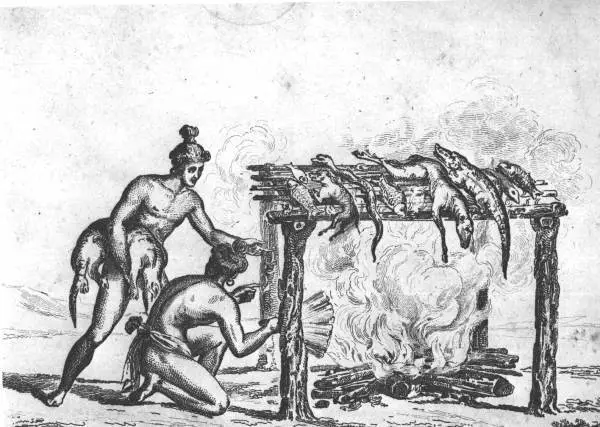
When British settlers arrived in Virginia, they encountered the meat-smoking techniques of the Powhatan people and merged them with their own methods. Barbecue as we understand it today was born from that collision. Southern barbecue then developed its own regional identities — vinegar-based in the Carolinas, mustard-forward in South Carolina, tomato-sweet in the Midwest — each one a record of the people who passed through and left something behind.
Act Two: The Political Feast
By the early 19th century, barbecue and the Fourth of July were already inseparable, but the tradition looked nothing like your backyard cookout. The Fourth was not yet a federal holiday. It wouldn't become one until 1941. But politicians in the South had figured out that nothing gathered a crowd like free food cooked over fire, and they used July Fourth as a stage.
These were not intimate gatherings. They were civic events, organized by committees of prominent local citizens, attended by entire communities, with whole animals cooked over trenches of burning hardwood coals. Oxen. Venison. Turkey. Ham. Whatever the farmers in the area could donate to the common cause. The naturalist John James Audubon described attending one such frontier celebration in Kentucky in the early 1800s, organized communally and open to all comers, with dancing that lasted until sundown and toasts that ran long into the evening.

As settlers moved west, they brought the tradition with them, and what had started as a Southern ritual became an American one. Town after town celebrated the Fourth in nearly identical fashion. The barbecue was the event. Everything else was secondary.
Then the Civil War happened. White Southerners largely stopped celebrating the Fourth after the Confederacy's defeat because the holiday reminded them of loss. But Black Americans kept celebrating it. Through Reconstruction, through the violence of the post-war South, through decades of being denied the promises the holiday was supposed to represent, Black communities maintained the July Fourth barbecue tradition with fried chicken and pork and all the food that had been central to Southern cookouts from the beginning. By 1901, the Atlanta Constitution was reporting that the Fourth of July in the South had become, as they put it, a day given over to Black Americans who celebrated it in "truly royal fashion." When white Southerners returned to the holiday in the 1920s, they were returning to a tradition that Black communities had kept alive. That is not a footnote. It is the story.
Act Three: Chicago Built the Backyard
Before World War II, the backyard cookout as we know it did not exist. There were no Weber kettles on suburban patios. There were no suburban patios. Meat had been rationed during the war and scarce before that during the Depression. When soldiers came home in the late 1940s, they wanted something modest: a small house, a patch of grass, and some peace. The suburbs answered that want, and millions of families moved out of cities and into yards they didn't quite know what to do with yet.
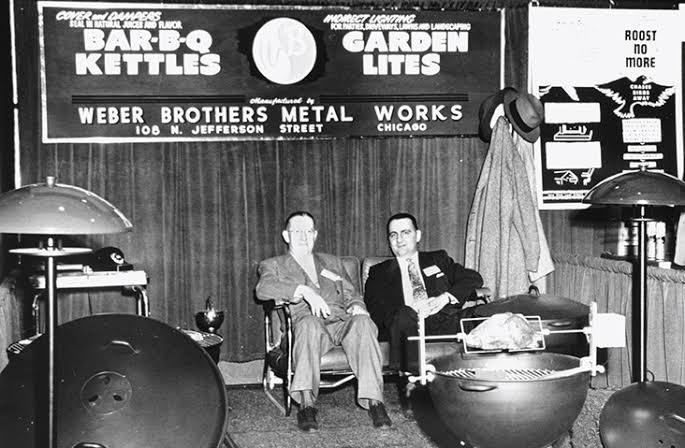
Enter George Stephen Sr., a salesman at Weber Brothers Metal Works on the northwest side of Chicago. Stephen was a father of twelve who loved outdoor cooking and was frustrated by the open charcoal braziers that passed for backyard grills in the early 1950s. They had no lids, no temperature control, and no defense against the wind. In 1952, he cut a metal Coast Guard buoy in half, welded on legs, added adjustable vents, and topped it with the other half of the buoy as a lid. He called it George's Barbecue Kettle and sold it for $29.95.
The timing could not have been more precise. Kingsford Charcoal, born from the leftover wood scraps of Henry Ford's factories, had just scaled up production to meet the growing demand from all these new suburban families. Magazines filled with images of men in aprons standing over grills. Advertisers sold charcoal, grill tools, and barbecue sauce as the vocabulary of the good life. The backyard became sacred ground, and the grill became its altar.
A Chicago metal worker, a Coast Guard buoy, and a country full of people who had been denied meat for years. That is how the American backyard cookout was invented.
Act Four: The Hot Dog Is Not American Either
The hot dog is the most American food at the most American holiday, and it was invented in Germany sometime around the 13th century. Frankfurt claims it. Vienna claims it. Both cities have been arguing about it for centuries, and the argument is beside the point. What matters is that German and Austrian immigrants brought the sausage to American streets in the 1860s, selling dachshund sausages from pushcarts in New York with sauerkraut and milk rolls, and the working class ate them because they were cheap, portable, and good.
A German immigrant named Charles Feltman put one in a bun at Coney Island in 1871 and built a restaurant around the idea. A Polish immigrant named Nathan Handwerker worked for Feltman, slept on the restaurant floor to save money, and in 1916 opened his own stand down the street. He sold his hot dogs for five cents, half of what Feltman charged. Nathan's Famous is still there.
The hamburger followed a similar path. Ground beef on a bun traces back to Hamburg, Germany. The first hamburger stands in America were opened by German immigrants. The word itself is German. We took it, put cheese on it, doubled the patty, and declared it our own.
This is what America does. It is not always a clean or comfortable process. But the hot dog you eat this weekend, the one that feels as natural as fireworks and sunscreen, arrived here in the hands of someone who had just crossed an ocean.
The Whole Thing, Together
The July Fourth cookout is the most American tradition we have because it contains all of us. The Caribbean people whose cooking method became our word. The Indigenous nations whose techniques became our cuisine. The Black Americans who kept the holiday alive when everyone else abandoned it. The German and Polish immigrants whose sausages became our national food. The Chicago metal worker who cut a buoy in half and gave every suburban backyard its centerpiece.
None of it was invented here. All of it became ours. That's not a contradiction. That's the country, at its best, doing the thing it occasionally manages to do: taking everything that arrives at its door and making something new out of it.
Fire up the grill. The story of how it got there is worth knowing.
Catch up
Recent Features

Coffee
Everything You Know About Coffee is Goatshit.
The Kaldi legend has been repeated for centuries. It has one problem: it never happened. Here's where coffee actually comes from, and why the person who pulled your shot deserves better than a fairy tale.

Coffee
Four Coffee Shop Red Flags
After half a million drinks behind the bar, I can size up a coffee shop before I even order. Here is what I am looking for and why it matters.

Chicago
The Som Tam Test: Taste the Freeland
How I judge Chicago's 300-plus Thai restaurants with one salad, and the four-hundred-year, multi-continent history hiding inside it.

