Miso Carbonara
Carbonara, Remixed.
Jump to Recipe

There are four ingredients in a real carbonara. Guanciale, egg, Pecorino Romano, black pepper. That is the whole list. Romans will tell you so, loudly, and they are mostly right. No cream. No garlic. No peas, no matter what somebody's aunt does on a Sunday. Carbonara is a dish defined as much by what it refuses as by what it contains.
I love that about it. I also ignored it.
Here is the thing about rules in a kitchen. You have to know them cold before you get to break them. Breaking a rule you never understood is just a mistake with confidence. Breaking one you respect is a point of view. So before anyone writes me an angry message: yes, I know. I know what carbonara is. This isn't an accident. It's an argument.
The argument is about umami, and where it comes from.
Pecorino Romano is doing more in a classic carbonara than people give it credit for. It's salt, sure. It's fat. But mostly it's umami, that deep savory hum that makes the dish taste like more than eggs and pork. Aged sheep's cheese is loaded with glutamates, the same compounds that make a good broth taste like it took three days. That hum is the actual job. The cheese is just one way to do it.
White miso does the same job. Fermented soybean paste is one of the most glutamate-rich things you can keep in a refrigerator, which is why a spoonful disappears into a sauce and leaves behind nothing but depth. It brings the savory floor that the cheese normally provides. Then it brings something the cheese can't: a low, tangy funk that reads as richness without reading as dairy. You taste it and your brain says carbonara. Then it pauses and says, wait, what was that.
That pause is the whole recipe.
So I traded most of the Pecorino for a generous tablespoon of white miso. Not all of it. A little cheese still goes in, because the goal was never to erase the dish. The goal was to bend it. Then I added two things that don't belong and absolutely should. A pinch of gochugaru, the smoky Korean chili flake, standing in for the black pepper and bringing a slow warmth instead of a sharp bite. And a scallion oil, blitzed bright green, drizzled over the top at the end to pull the Italian and the Asian halves of this plate into the same sentence.
The scallion oil is worth making for its own sake. Blanch the green tops of a bunch of green onions for thirty seconds, shock them in ice water to lock the color, then blend them with good olive oil and a little flake salt until smooth. That's it. You'll have more than you need, which is the point. It keeps, and it makes almost anything look and taste like you tried harder than you did. Eggs. Roasted vegetables. The next bowl of noodles. Make it once, use it all week.
Now, the part where I tell you not to be scared.
Carbonara has a reputation for being a technical minefield, and that reputation is half earned. There is exactly one moment where it can go wrong, and it's the emulsion. Everything before that is just cooking pasta and rendering pork. The trick is heat management, and the trick within the trick is patience.
You temper the eggs first. That means warming them gently with a little of the rendered guanciale fat, whisking the whole time, so they get used to heat before they ever touch the pan. Skip this and you get scrambled eggs with ambition. The fat has to sit off the heat for a minute or two before it goes in. Too hot and you've cooked the yolks before the sauce ever forms. Warm, not searing. Coaxing, not cooking.
Then you bring it together off aggressive heat. Noodles, tempered egg, a splash of starchy pasta water, and a lot of stirring. The starch in the water is what lets the fat and the egg hold hands instead of breaking up. You stir, it thickens, it turns glossy and creamy, and for a second you'll think you did something wrong because it looks too loose. You didn't. The sauce thickens as it cools, so you want to pull it while it still moves. Err looser than feels right. A carbonara that looked perfect in the pan is usually a little tight on the plate.
If it does start to seize, the fix is simple. Pull the pan off the heat and keep stirring fast. Add a splash more water. The emulsion is forgiving if you stay calm and stop applying heat. The only unrecoverable carbonara is the one you panicked over.
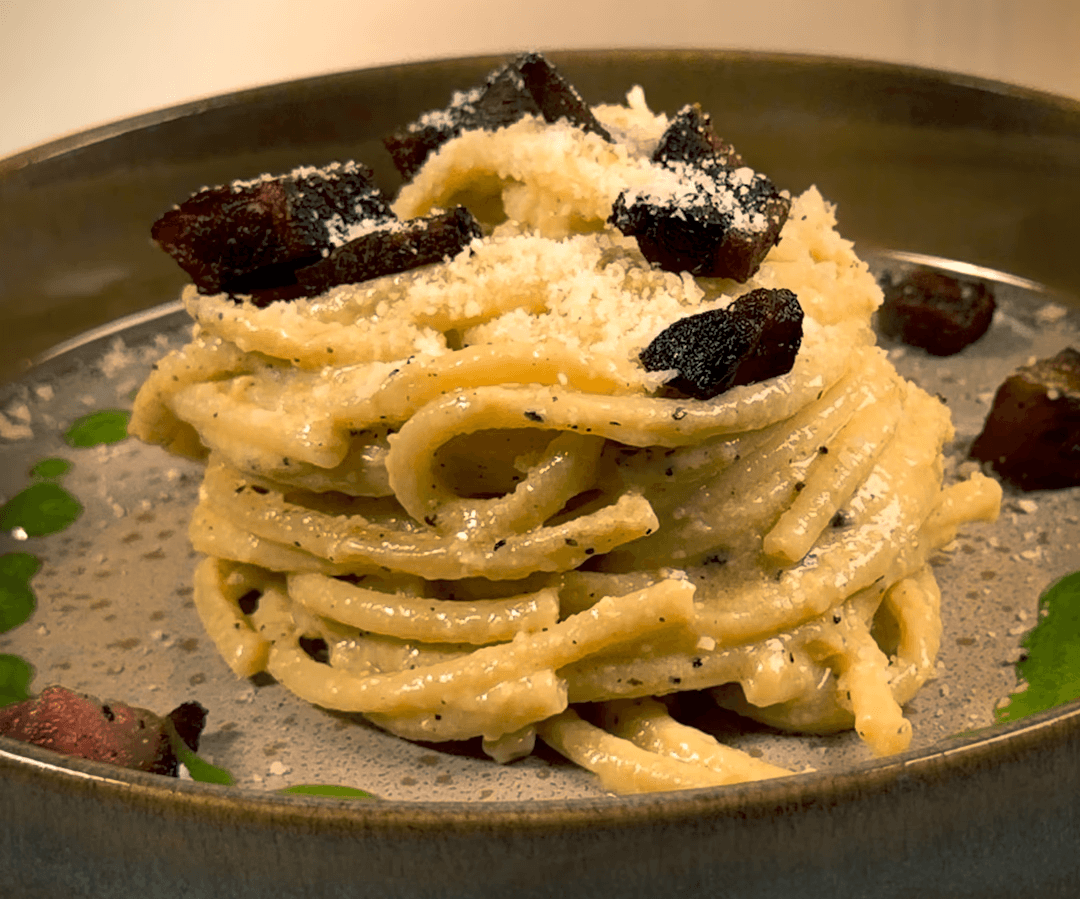
This is a recipe built for two, eaten across a small table, ideally with somebody who will fight you for the last twirl. It scales up fine for four or six. Just move to a wider pan so the noodles have room to be tossed instead of crowded. It happens fast, it tastes like it took longer than it did, and it makes a quietly convincing case that the rules are a starting point and not a fence.
Carbonara is sacred. That's exactly why it's fun to nudge. Make it once the right way so you know the sound it's supposed to make. Then make this one, and listen for the pause.

Recipe
Scallion Oil (makes extra)
1 bunch green onions, green tops only
1/2 cup good olive oil
1 pinch Maldon flake salt
The Pasta
1/2 lb guanciale, cut into large cubes (pancetta or bacon work fine)
1/2 lb bucatini (spaghetti works too)
3 egg yolks
1 whole egg
1/4 cup Pecorino Romano, finely grated, plus more to finish
1 generous tablespoon white miso
1 pinch gochugaru (or freshly cracked black pepper)
Reserved pasta water, at least 1 cup
Salt for the pasta water
Steps
Make the scallion oil.
Blanch the green onion tops in boiling salted water for no more than 30 seconds, just until softened, then transfer immediately to an ice bath. Drain well. Blend with the olive oil and a pinch of flake salt until smooth and bright green. Set aside. You'll have more than you need, and that's intentional.
Render the guanciale.
Place the cubes in a cold saute pan (a 10-inch pan is right for two; size up to 12 inches for a larger batch). Bring to medium heat and render until the fat turns golden and the cubes go crispy, about 7 to 10 minutes. Remove the crispy bits and reserve. Keep all the fat in the pan, and pull the pan off the heat.
Build the sauce base.
In a bowl, whisk the egg yolks, whole egg, Pecorino, white miso, and gochugaru together vigorously until fully combined. Whisk hard. You want it smooth and uniform.
Cook the pasta.
Boil the bucatini in well-salted water to package instructions. Before draining, reserve at least 1 cup of pasta water. Save more than you think you need.
Temper the eggs.
The rendered fat should have sat off the heat for a minute or two so it's warm, not screaming hot. Whisk a couple of spoonfuls of that fat into the egg mixture, a little at a time, whisking constantly. This warms the eggs gently so they won't seize when they hit the pan.
Emulsify.
Return the pan with its remaining fat to medium-low heat. Add the drained noodles, then pour the tempered egg mixture over them. Add about 1/2 cup pasta water and stir vigorously to pull the noodles, egg, and water into a glossy, creamy emulsion. If the eggs start to separate or scramble, pull the pan off the heat immediately and keep stirring fast. Loosen with more pasta water as needed. The sauce thickens as it cools, so leave it slightly looser than looks right.
Plate. Twirl the pasta into a mound on a warm plate. Spoon any extra sauce over the top. Finish with the reserved crispy guanciale, a little more Pecorino, and a drizzle of scallion oil.
At a Glance
Prep Time:
5
Cook Time:
20 Minutes
Serves:
2 (easily scales)
Difficulty:
Intermediate
Miso
Italian
Intermediate
30 Minutes
Dinner
FRESH ON THE MENU
Latest Recipes

Category
One pot, whatever vegetables you’ve got, and dinner on the table before delivery finds your building.
Lemon Chicken Orzo for When You Don’t Want to Cook

Category
Czech bread dumplings: yeasted dough, stale bread, and a pot of boiling water.
Knedlíky

Category
Czech braised beef in a blended root vegetable cream sauce, made for Allen’s 40th on a Wednesday.
Svíčková

Category
Beef fat stands in for pork belly in a lazy one-pot stew that waits until everyone gets home.
Skirt Steak Kimchi Jjigae with Leftover Pot Roast Fat